On Friday 14th August I went to Edinburgh to take part in Verture’s Becoming Climate Resilient training. As part of our new Arran Community Climate Action project we will be developing a program of Local Resilience Workshops. These will support the Arran community to build resilience to the impacts of a changing climate.
Attendees came from a mix of sectors; SEPA, Advisers to Scottish Government, Actuaries, Business advisors, Flood agencies and community organisations. Having such a cross-section of participants made for interesting group discussions when thinking about adaptation in our organisations!
What does a Climate Changed UK look like?
The morning began with a session looking at what a Climate Changed UK looks like. Exploring changes both at a physical level and changes that Scotland’s people, communities and organisations may experience. We examined the implications of a climate in which summers were warmer and dryer, winters wetter, sea levels higher and weather more unpredictable. And the associated impacts this has across all aspects of life. I.e soil quality, agricultural productiveness, health of our natural environment, health and wellbeing of our people, resilience of our businesses etc.
One of the trainers shared with us that her family home was at that moment two roads away from the wildfires which were tearing through houses in the West Midlands. This really drove home the reality that climate change impacts are not an abstract future problem but are being felt here and now.
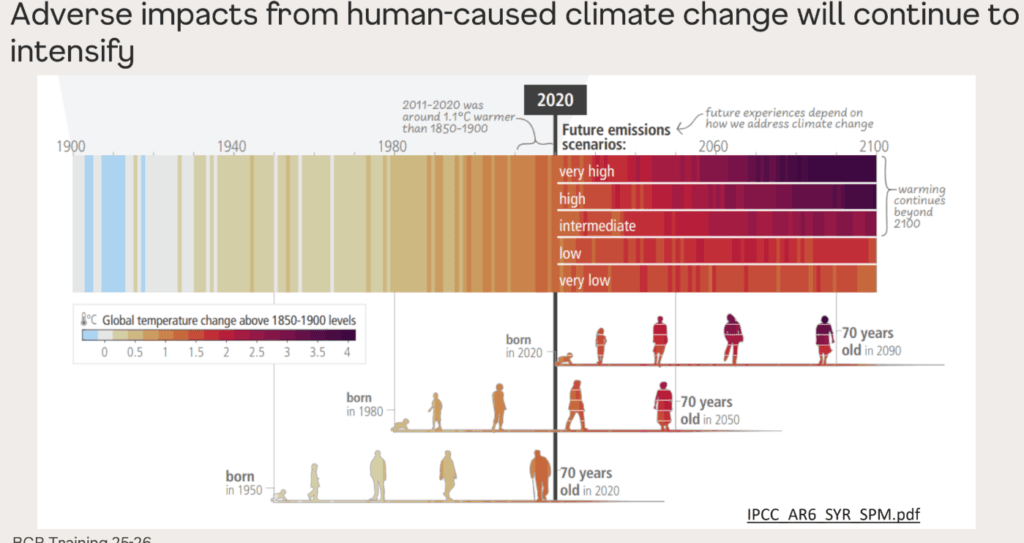
Without significant efforts towards net-zero through mitigation of greenhouse gas emissions then adverse impacts from Climate Change will continue to intensify. The chart below was confronting in demonstrating this. It shows different emission scenarios leading to varying degrees of heating. Knowing that no-one born today will ever experience weather like I did growing up in the 90s and 00s was shocking.
Responding to Climate Change
The hopeful part about this is that at this time higher levels of heating are by no means guaranteed. Nevertheless progressing towards Net Zero will limit the likelihood of these scenarios.
There is a consensus that we have, however, locked in a certain amount of heating and that this requires Adaptation. These are actions to reduce vulnerability to the actual or expected impacts of Climate Change. On a practical level this means things like ensuring our buildings are built to cope in a new climate, building flood and drainage infrastructure that can handle excess rainfall, planting more trees in urban areas to provide shading etc.
If we understand Adaptation as a process; ‘the action to reduce vulnerability to the actual or expected impacts of Climate Change’. Then Resilience is a state where we have ‘the capability to anticipate and withstand Climate impacts while maintaining an ability to provide essential services and the capacity to repair, flourish and thrive in the future.’
Thriving, not just surviving
Thinking about adaptation is a way to become less reactive and more solutions focussed. Underpinning this is a belief that by building resilience we can move beyond survival towards thriving. In a changing world we have the opportunity to collectively choose what changes we want to make. Often adaptations have many co-benefits. I.e investing in attractive, shaded cycle paths reduces air pollution, minimises car journeys, improves health and creates more green spaces. Though there may be trade-offs to consider, high up front investment for example. We should ultimately be working towards building a future where we can all flourish.
We have to ensure Just Resilience. This recognises that Climate Risk is unequal and that those least responsible for climate emissions are also those who are typically most impacted by Climate Change. This is Climate (in)justice. We need to build a fair future that gives everyone in Scotland the capacity to flourish and thrive.
Taking action to build Resilience
After lunch we worked through some ‘enablers’ and ‘barriers’ to making adaptation actions through our organisations. Enablers included things like funding to deliver Community Resilience workshops locally. Whilst a barrier could be the technical knowledge to provide guidance. (Luckily we have great connections and will make sure to bring some experts along to our future workshops!).
We finished up with some work on understanding our influence. Including the need to focus our energy and actions to areas where we can be useful, have a direct impact and help create change. For my often overwhelmed brain, this was the perfect place to end the training. We need to be aware of the greater challenges but our focus must be on things we can directly impact.
Over the next 2 years Eco Savvy will be running a series of Climate Resilience workshops. These will be on topics such as storm proofing, managing flood risk, preparing for extreme weather and any other subjects that we as a community are interested in learning more about. To keep updated with our workshops please subscribe to our newsletter or email me on jess@arranecosavvy.org.uk if you have ideas for subjects we can explore together.
Share this article