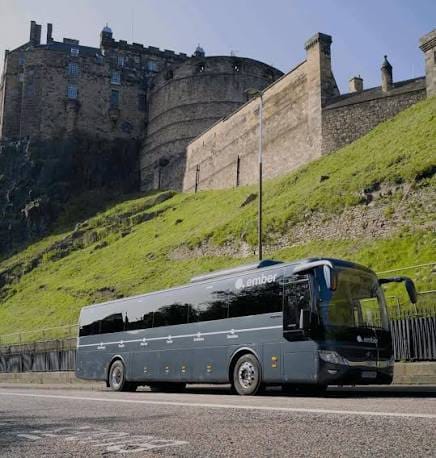
Travelling through Scotland recently, I noticed something that really caught my attention: Ember electric coaches seemed to be everywhere.
On a weekend trip up to Aberdeen, travelling through Edinburgh, Stirling and Dundee, I was struck not only by how many Ember coaches I saw on the road, but by how distinctive they looked. Their sleek, matt-black design immediately caught my eye. They look modern, smart and noticeably different from the traditional coaches we’re used to seeing on Scotland’s roads.
There was something quite exciting about repeatedly spotting these sleek black electric coaches throughout the journey. Rather than electric public transport feeling like an idea for the future, here it was, travelling up and down Scotland every day.
And it got me thinking.
For an island community like Arran, where travelling further afield often means combining a ferry with a bus, train or car journey, could services like Ember eventually become part of how we travel to and from the island too?
So, who are Ember, how do their electric coaches work, how quickly are they expanding, and could we one day step off the ferry at Ardrossan or Troon and onto an electric coach towards Glasgow?
Who are Ember?
Ember launched its first service in 2020, initially operating between Dundee and Edinburgh with just two electric buses.
The company set out to demonstrate that electric vehicles could work for intercity travel, rather than electric buses being limited to shorter urban routes.
Since then, the network has grown significantly.
Today, Ember operates routes connecting destinations across Scotland, including Edinburgh, Glasgow, Dundee, Aberdeen, Inverness, Fort William and Oban, alongside airports, towns and smaller rural communities.
What began with two electric buses travelling between Dundee and Edinburgh is becoming a much wider electric public transport network.
How do Ember’s electric buses work?
One of the most interesting things about Ember is how intensively the company uses its electric fleet.
Ember says its buses can travel up to around 350 miles on a single charge. Rather than simply charging overnight and operating during the day, the buses can charge multiple times throughout the day.
This allows each vehicle to travel almost 200,000 miles per year.
The buses use LFP batteries, which are cobalt-free, and Ember says that using the vehicles so intensively helps reduce their lifetime emissions when compared with a diesel equivalent.
The passenger experience is different too. Electric coaches are much quieter than conventional diesel vehicles, with no engine rumble or exhaust fumes.
Building Scotland’s electric charging network
Operating electric coaches over hundreds of miles also requires somewhere to charge them.
Ember is therefore developing its own network of ultra-fast charging hubs across Scotland.
It currently has charging infrastructure in locations including Dundee, Aberdeen, Inverness, Oban, Thurso, Fort William and Perth, with further hubs planned in places including Paisley and Livingston.
What’s particularly interesting is that Ember isn’t keeping all of this infrastructure to itself.
The company is opening its charging network to other bus, coach and HGV operators, potentially helping other transport providers make the switch to electric vehicles too!
Its chargers can offer speeds of up to 300kW, allowing large electric vehicles to recharge relatively quickly before heading back onto the road.
Making electric travel easy to use
Of course, reducing emissions is only part of the challenge.
If we want more people to leave their cars at home, public transport also needs to be easy, reliable and convenient.
This was another part of Ember that caught my attention when I started looking into how the service works.
Booking an Ember coach is remarkably straightforward. You can search for your journey and book online, and the company’s live map shows its routes and stops across Scotland.
You can even use the same map to track your bus in real time, rather than standing at a stop wondering when it is going to arrive.
Tickets are also flexible. If your plans change, Ember allows online tickets to be changed or cancelled, while bike and wheelchair spaces can be reserved at no additional cost.
For those of us travelling to and from an island, that sort of flexibility is particularly appealing. Ferry travel doesn’t always go exactly to plan, so having onward transport that is easy to book, track and change could make a real difference.
A clever approach to serving smaller communities
Perhaps one of the most interesting parts of Ember’s model is how it serves smaller towns and villages without unnecessarily slowing down the entire journey.
Most Ember stops are demand responsive.
This means that rather than every coach stopping at every stop along its route regardless of whether anybody is waiting, passengers book the stop they need in advance.
For the vast majority of these stops, Ember allows passengers to book up to around 10 minutes before the scheduled departure time.
If someone has made a booking, the coach calls at the stop. If nobody has booked, it can continue on its journey. It’s a simple idea, but a clever one.
It allows Ember to keep longer journeys relatively fast while still providing public transport connections to smaller villages and communities along the route.
When passengers search for a ticket, the booking system clearly identifies which stops need to be pre-booked.
For rural Scotland, this type of transport model is particularly interesting. It demonstrates that serving smaller communities doesn’t necessarily have to mean creating a slow service that stops everywhere on every journey.
Scotland’s electric coach network is growing
Perhaps what struck me most during my journey to Aberdeen was the scale at which Ember now seems to be operating.
Seeing one electric coach is interesting. Seeing them repeatedly as you travel across Scotland feels very different. It was like playing spot the yellow car!
The company has been expanding rapidly.
Its network now includes connections between Dundee, Aberdeen, Edinburgh, Glasgow, Oban, Fort William and Inverness, alongside many of the towns and villages between them.
Recent expansion has included routes between Glasgow and Oban, Glasgow and Fort William, Inverness and Ullapool, and new and expanded services through Perth, Dundee, Angus and Aberdeenshire.
Ember has also introduced connecting tickets across parts of its network, making it possible to combine services to make longer journeys across Scotland.
It’s beginning to look less like a collection of individual electric bus routes and more like a genuinely interconnected network.
And what about Glasgow?
For us on Arran, Ember’s expansion into Glasgow and the west of Scotland is particularly interesting.
Ember already operates services connecting Glasgow with destinations including Oban, Fort William and Dundee, as well as serving Glasgow Airport and communities to the west of the city.
The company is also developing a new rapid-charging hub in Paisley.
There is currently no announced Ember route connecting Ardrossan or Troon with Glasgow, so this next part is very much wishful thinking on my part!
But seeing how quickly the network has expanded does raise an interesting question.
Could Ayrshire eventually become part of Ember’s network too?
What could this mean for Arran?
At the moment, travelling from Arran to Glasgow often involves taking the ferry to Ardrossan or Troon before continuing by train, bus or car.
Imagine instead being able to step off the ferry and connect with an electric coach heading towards Glasgow.
Even more interestingly, Ember’s demand-responsive model could potentially lend itself well to places where passenger numbers vary throughout the day.
A service wouldn’t necessarily need to stop at every location on every journey. Instead, stops could be served when passengers had actually booked to travel.
I’m certainly not suggesting that Ember has plans to do this, there are currently no announced routes to Ardrossan or Troon, but their model provides an interesting example of how public transport could work differently in the future.
For residents, commuters and visitors, better connections between ferry terminals and onward public transport could provide another alternative to taking a car onto the ferry.
Connecting ferries with sustainable public transport
For island communities, improving sustainable transport isn’t simply about what happens on the island.
Our transport network stretches much further.
A journey from Arran to Glasgow might involve walking, cycling or taking a bus to the ferry terminal, travelling across the Clyde and then connecting with another form of public transport on the mainland.
If we want people to feel confident leaving their cars behind, those different parts of the journey need to work together.
That means thinking about ferries, buses, trains, cycling infrastructure and emerging electric transport networks as one connected system.
It also means making those services easy to use.
Being able to book a coach minutes before it arrives, see exactly where it is on a live map and serve smaller communities only when passengers need the stop might seem like relatively small innovations.
Together, however, they can make public transport feel considerably more convenient.
Electric public transport is already here
It is easy to talk about the transition to lower-carbon transport as something that will happen years from now.
My trip to Aberdeen was a nice reminder that parts of that transition are already happening.
Seeing those distinctive matt-black electric coaches appearing again and again as I travelled north made Scotland’s move towards electric public transport feel very real.
Ember began with just two electric buses and one intercity route. Today, its network stretches across a significant part of Scotland, connecting major cities with airports, towns, villages and rural communities.
There is still a long way to go when it comes to creating an affordable, reliable and genuinely integrated public transport network, particularly for rural and island communities.
But Ember provides a really interesting glimpse of what that future could look like.
And who knows?
Perhaps one day a journey from Arran to Glasgow really could involve stepping off the ferry at Ardrossan or Troon and straight onto a sleek, matt-black electric coach!
We’d certainly like to see it.
Share this article